
How AED maintenance can support your compliance
AEDs play an important role in helping to save lives. Survival rates decline with each minute that passes without the administration of CPR and an AED, and in many communities, overall survival unfortunately remains below 10%, according to the Heart and Stroke Foundation.
Having an AED on site is an important part of your commitment to employee safety. But AEDs only work if they are well maintained.
See how regular AED maintenance not only strengthens your workplace's safety culture but supports your legal and regulatory compliance.
Many Provincial laws require AEDs with regular maintenance and testing
Many provinces have laws governing AEDs in certain settings such as gyms, schools, and public buildings. Mandatory AED installation, registration, and maintenance are listed among these requirements.
For example, Manitoba requires maintenance and testing of AEDs located in high-traffic public places such as gyms, arenas, community centres, golf courses, schools, and airports. The Defibrillator Public Access Act requires owners of designated premises to maintain their AEDs in accordance with the Regulation. This includes performing a monthly inspection and addressing any service alerts.
CCOHS encourages AEDs and training
Although CCOHS does not require AEDs in all Canadian workplaces, it encourages the installation and training of AEDs and recognizes their value as part of first-aid programs and in helping to save lives.
Good Samaritans laws protect AED users
All Canadian provinces have some form of Good Samaritan law that provides liability protection for AED users who act in good faith.
Documentation and recordkeeping simplify compliance support
Keeping an accurate record of AED maintenance and testing can help you be compliant with local and national requirements and regulations.
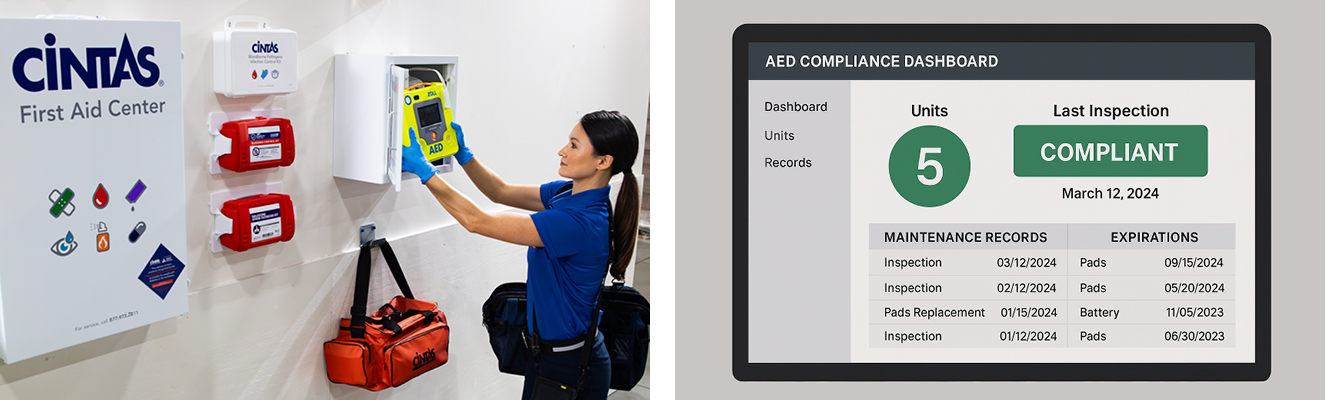
Partnering with an AED service provider like Cintas gives you on-site installation assistance as well as monthly visual inspections, testing, and regular software updates.
Plus, they can help with documentation and recordkeeping. Cintas offers an online portal that makes it simple for you to access your AED inventory, maintenance records, and usage, making it easier for you to track.
Learn how a Cintas AED service program can keep you stay rescue-ready and compliant.
Customer is solely responsible for conducting its own risk or hazard analysis, for obtaining regulatory guidance, for choosing the type and number of AEDs needed, and for the placement of those AEDs at Customer’s facilities. Any services provided by Cintas are limited to those explicitly contracted for by Customer. If Customer has entered into a service or maintenance agreement with Cintas, Customer is responsible for notifying Cintas of any faults, alarms, or indications that the AED is not functioning properly between Cintas’s periodic service or maintenance visits. Customer is responsible for ensuring compliance with all applicable laws and, if necessary, must obtain a prescription for the AEDs, ensure that the AEDs are subject to medical oversight, and take all other necessary steps to comply with applicable law. Cintas is not a health care provider and does not issue prescriptions, provide medical oversight, or provide other related health care or medical services. Rather, if explicitly contracted for by Customer, Customer receives access to a third party who can provide a prescription for the AEDs, provide medical oversight, register the AEDs with local EMS, and provide Customer access to the third-party’s online software portal.