
Before, during, and after: How an AED service program supports you through a cardiac emergency
The unthinkable is happening. One of your employees is experiencing sudden cardiac arrest. What do you do?
Act quickly. Three things you should do right away:
- Call 911.
- Begin CPR.
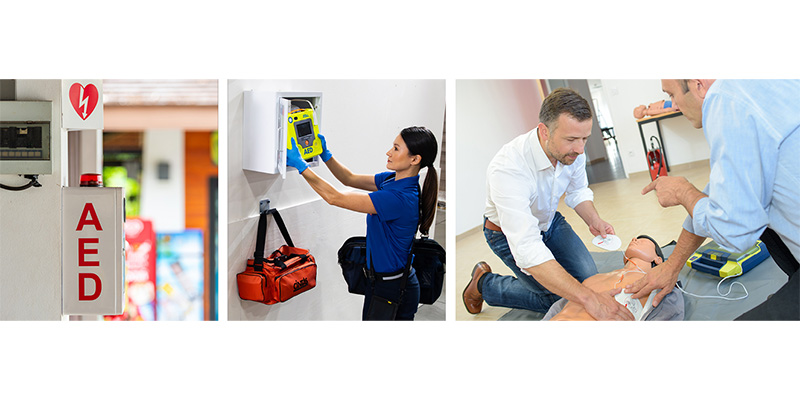
- Use your AED to provide a defibrillating shock to help restore a normal heartbeat.
Many AEDs offer voice prompts and real-time instructions with CPR guidance, helping you know what to do next and if your chest compressions are deep enough to be effective.
Immediate response is key during sudden cardiac arrest. Overall survival following sudden cardiac arrest (SCA) can fall below 10% in many communities, and each minute without immediate CPR and AED use sharply reduces a person’s chance of surviving, according to the Heart and Stroke Foundation.
Having an AED that is easily accessible is important. The Heart and Stroke Foundation reports that about 60,000 cardiac arrests happen each year, highlighting why being prepared at work matters.
In moments like these, being prepared means everything. Having an AED on site that is easily accessible and having your employees trained to help can make all the difference.
Emergency medical staff has arrived. You’ve helped save a life. What’s next?
Your team’s quick action made all the difference. Emergency medical personnel have arrived and will help get your employee the medical care they need.
You can breathe a sigh of relief. But what if the medical professionals caring for your employee request electrocardiogram (ECG) data for physician oversight to help with the diagnosis and to understand the cause of the cardiac emergency?
Luckily, AEDs store the event memory needed to provide that information. Partnering with an AED service provider like Cintas can help you access and download the data.
Beyond the ECG download: How else an AED service program can support you after a cardiac event
Since AEDs are not “install and forget” devices, AED service programs can help provide monthly service visits for preventative maintenance. But did you also know your AED service provider can help following an emergency?
Cintas offers dedicated professionals who you can contact immediately after an AED is used. Within one to two days, they will visit your facility and restock your used electrode pads and provide a loaner AED, if you need one.
Your representative can also help you with documentation and recordkeeping. Cintas offers an online portal that makes it simple for you to access your AED inventory, maintenance records, and usage, making it easier for you to track and stay compliant with local and national requirements and regulations.
Equip your team with the life-saving resources they need
In addition to having a well-maintained AED on site, it is important for your employees to know how to respond in the event of an emergency.
As a national provider of CPR and AED training, Cintas offers engaging, hands-on instruction to help your staff feel confident and prepared.
Emergencies can strike anytime. It’s important that your AED is functioning properly and your team is empowered to act should the unthinkable happen again.
Learn how a Cintas AED service program can help you stay rescue ready. Schedule a free onsite AED readiness review today.
Customer is solely responsible for conducting its own risk or hazard analysis, for obtaining regulatory guidance, for choosing the type and number of AEDs needed, and for the placement of those AEDs at Customer’s facilities. Any services provided by Cintas are limited to those explicitly contracted for by Customer. If Customer has entered into a service or maintenance agreement with Cintas, Customer is responsible for notifying Cintas of any faults, alarms, or indications that the AED is not functioning properly between Cintas’s periodic service or maintenance visits. Customer is responsible for ensuring compliance with all applicable laws and, if necessary, must obtain a prescription for the AEDs, ensure that the AEDs are subject to medical oversight, and take all other necessary steps to comply with applicable law. Cintas is not a health care provider and does not issue prescriptions, provide medical oversight, or provide other related health care or medical services. Rather, if explicitly contracted for by Customer, Customer receives access to a third party who can provide a prescription for the AEDs, provide medical oversight, register the AEDs with local EMS, and provide Customer access to the third-party’s online software portal.